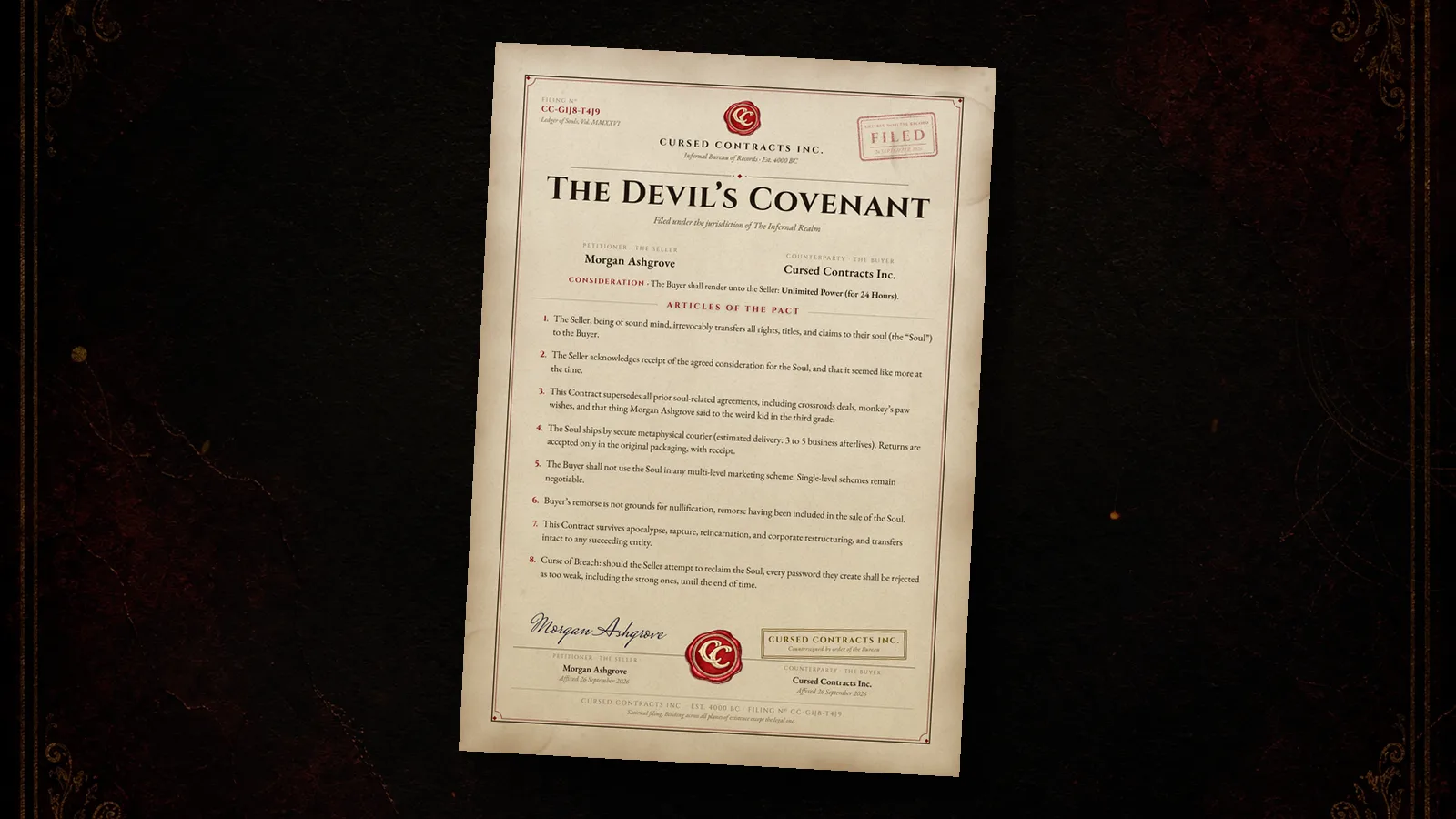
The Bureau receives a steady volume of enquiries on this subject, most of them after midnight. What follows is the current procedure for selling a soul through Cursed Contracts Inc. It replaces all earlier guidance, including anything a stranger at a crossroads may have told you.
Step 1: Establish that you have a soul
The Bureau does not verify this. Petitioners are asked to confirm it themselves, in good faith, on the form. In four thousand years of records, nobody has answered "no."
Step 2: Choose the acquiring party
Historically, souls were sold to the devil directly, at crossroads, in dreams or through intermediaries. These methods produced disputes. (See Famous Deals With the Devil for the full record.)
Today most petitioners sell to one of two parties:
- The Bureau itself. The standard arrangement. The Bureau countersigns on its own behalf.
- Another person. A friend, a partner, a sibling or a coworker, who becomes the Acquiring Party and must countersign. This is the more popular option, and the more dangerous one, because that person will keep the copy.
Step 3: Name your consideration
This is the part petitioners get wrong. The consideration is what you receive in exchange for the soul, and vague consideration leads to monkey's paw outcomes. "Unlimited power" is on the form, but the Bureau's standard terms add a duration. "One (1) Garlic Knot, Surrendered Warm" is specific and, in the Bureau's experience, far more likely to be delivered.
Be specific. Be modest. Accept that it will seem like less once the deal is done. Clause 2 of the standard instrument notes that the Seller acknowledges receipt of the consideration, "and that it seemed like more at the time."
Step 4: Read the clauses
The Devil's Covenant, the Bureau's founding instrument, contains eight articles. Petitioners should note in particular:
- The transfer. You irrevocably transfer all rights, titles and claims to the Soul.
- The supersession clause. The contract replaces all prior soul-related agreements, "including crossroads deals, monkey's paw wishes, and that thing the Seller said to the weird kid in the third grade."
- Shipping. The Soul ships by secure metaphysical courier, in three to five business afterlives.
- Restrictions. The Buyer may not use the Soul in a multi-level marketing scheme. Single-level schemes remain negotiable.
- Remorse. Buyer's remorse is not grounds for cancellation, remorse having been included in the sale.
Every article can be amended before signing. Most petitioners do not read them. The Bureau recommends that you do, and expects that you won't.
Step 5: Sign, and obtain the countersignature
Affix your mark: drawn is traditional, typed is accepted. Then send the contract to the Acquiring Party. The filing is not complete until both marks are on it. Blood is no longer required and is discouraged by Facilities.
Step 6: Receive your filing number
Once countersigned, the contract is sealed and entered into the record with a filing number. You may keep a copy, print it, frame it or share it. The Bureau keeps the original.
Step 7: Commit it to the archive (optional)
A soul sale that exists only on a screen is easily lost, which defeats the purpose of a permanent transaction. The Company Store issues any filed contract in three formats. Checkout happens on Etsy, where you paste your filing number and see the final price in your own currency:
- Certified Copy, about US$7: the sealed, numbered contract as a PDF, a second copy with blank signature lines for signing by hand, and a phone wallpaper. Delivered after purchase.
- Unframed print, about US$29: matte paper, made to order, with a production time of five to seven days.
- Framed print, about US$64: the same print in a black wooden frame. The usual choice for a soul sale given as a gift.
Prints ship free to the US, EU, UK, Canada and Australia. The Bureau notes that a framed soul contract above a desk has a measurable effect on visitors.
Consideration the Bureau has accepted
Petitioners struggling with Step 3 may draw on precedent. Each of the following has been filed, countersigned and, as far as the Records Office knows, delivered:
- One (1) Garlic Knot, Surrendered Warm
- A Lifetime Supply of Irony, in lieu of monetary compensation
- Three (3) favors, redeemable without explanation
- First Claim on Every Last Slice
- Custody of the Good Side of the Bed
- One (1) Airport Ride, including departures before 6 AM
- Twelve (12) Coffees, Correctly Ordered
- Unlimited Power, for a period of one (1) fiscal quarter
Note the pattern. Small, specific and slightly embarrassing considerations make better documents than grand ones, and they are much easier to collect.
Selling your soul as a gift
The most common filing in the Bureau's current records is not a petitioner selling their own soul. It is a petitioner drawing up a soul contract for someone else: a friend's birthday, a partner's anniversary, a colleague who has been asking for it. The procedure:
- Name the recipient as The Petitioner and yourself as The Acquiring Party, or the reverse, depending on who is owed what.
- Write a consideration that refers to something real between you.
- Amend one or two articles to mention them by habit. The Bureau's clauses are a starting point, not scripture.
- Send it for their signature. The moment they read the fine print is the gift.
- Frame it afterwards, if the countersignature goes well.
For other paperwork suited to the nocturnal, see the Bureau's gothic gift ideas. For why the arrangement has always ended badly for the Seller, see what a Faustian bargain means.
Common filing errors
The Complaints Desk in the subbasement reports the same four errors every year:
- Vague consideration. "Happiness" is not a deliverable. The Bureau cannot ship it.
- No countersignature. An unsigned soul contract remains a draft, and drafts are not binding even in the Bureau's own jurisdiction.
- Signing both lines yourself. This is technically a soul sale to yourself. The Bureau files it under self-improvement.
- Skipping the fine print. See Step 4. It is all in Step 4.
Frequently asked questions
Is it legally binding?
Under the laws of your jurisdiction, no. Under the Bureau's, the matter is closed. Cursed Contracts are satirical documents: they can be signed, sealed, printed and framed, but they transfer nothing, legal or metaphysical. The footer of every page says so, and every soul filed so far remains with its owner.
Can I sell someone else's soul?
Only with their signature. A soul sale with one signature is a wish, and the Bureau does not process wishes. Name the other person as the Petitioner, send the contract for countersignature, and let them read the clauses first. The Bureau recommends they do; it expects they will not.
Can I get my soul back?
Petitioners who try invoke the curse of breach: every password they create is rejected as too weak, including the strong ones, until the end of time. Theophilus of Adana is the only petitioner on record to recover a contract, and he needed a saint to do it.
What does it cost?
Drafting, signing and countersigning are filed at no cost. Framing is extra: through the Company Store, the Certified Copy PDF is about US$7, an unframed matte print about US$29 and a black-framed print about US$64. Prints ship free to the US, EU, UK, Canada and Australia.
Begin
The Devil's Covenant is open for filing, and can be started directly on the filing desk. The Bureau is open late.