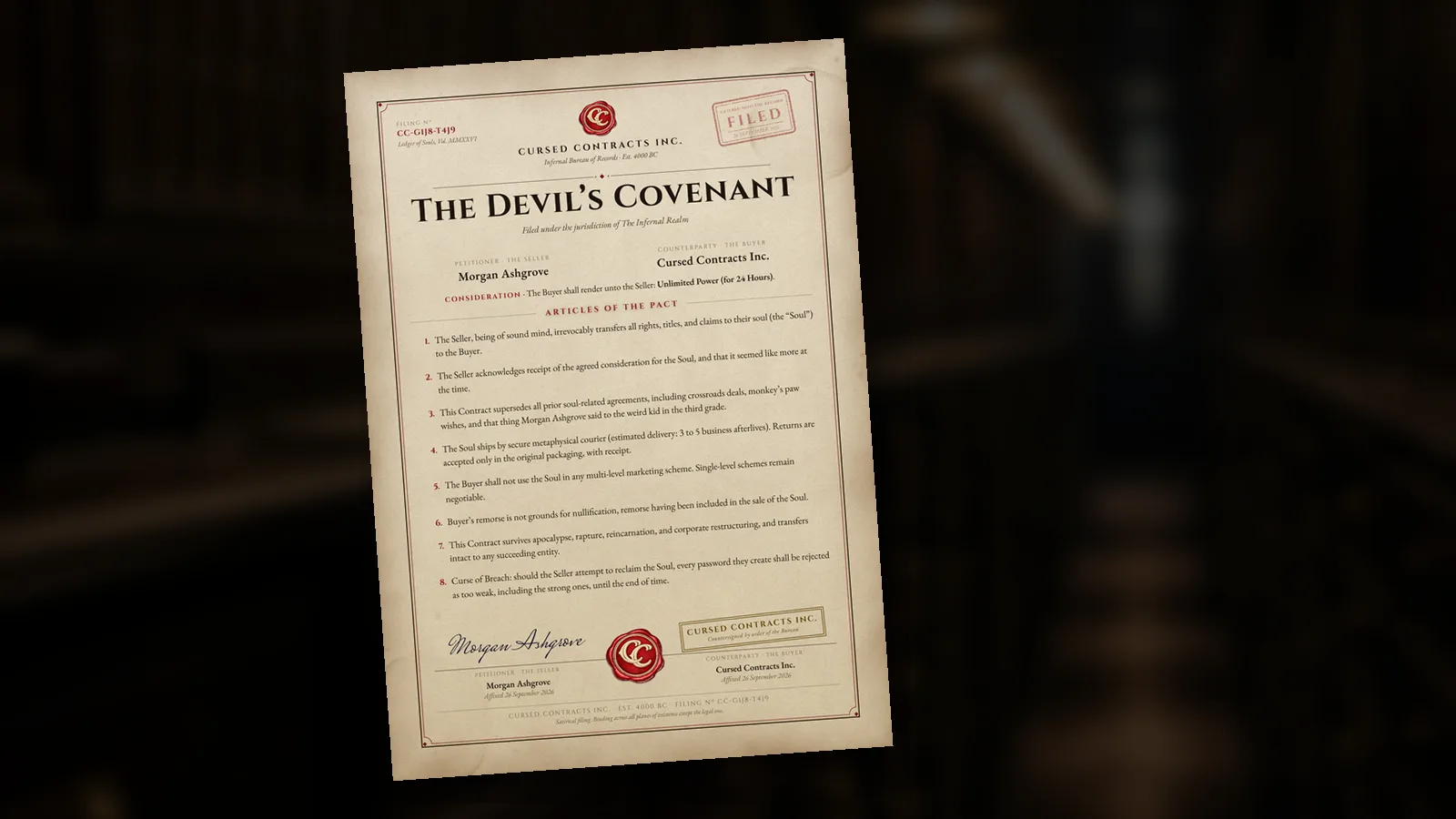
A Faustian bargain is a deal in which someone gives up something of lasting value (integrity, health, freedom, their future) in exchange for something they want now (power, knowledge, money, pleasure). The phrase implies that the person knew the price, or should have, and that the price will be collected.
The Bureau has administered this kind of arrangement for some time. The name, however, belongs to one client in particular.
Who was Faust?
There was a real Faust. A travelling scholar, astrologer and self-styled magician called Johann Georg Faust (or Faustus) appears in German records in the early sixteenth century and died around 1540. His contemporaries described him as a braggart and a fraud. Stories about him grew quickly after his death, and the most durable story was that his learning had been purchased from the Devil.
The contract, as first published
In 1587 a Frankfurt printer, Johann Spies, published the Historia von D. Johann Fausten, usually called the Faustbook. It tells how Faust, frustrated by the limits of human knowledge, summons a spirit named Mephistopheles and signs a pact in his own blood.
The terms, as the story gives them, are admirably clear:
- Term: twenty-four years.
- Consideration: a spirit at Faust's service, answering every question and granting what he asks.
- Price: at the end of the term, Faust's body and soul.
- Conditions: Faust renounces his faith and may not marry.
He uses the years for travel, spectacle and increasingly petty tricks. When the term expires, he is collected. The book ends as a warning.
Marlowe, Goethe and the long afterlife
The Faustbook was translated into English within a few years, and Christopher Marlowe turned it into a play, The Tragical History of Doctor Faustus, performed in the early 1590s. Marlowe keeps the twenty-four years and the blood signature, and gives Faust a final speech in which he begs the clocks to stop. They do not.
Johann Wolfgang von Goethe spent most of his life on Faust, published in two parts in 1808 and 1832. Goethe changed the terms. His Faust makes a wager rather than a fixed-term sale: Mephistopheles may have him on the day Faust is so satisfied with a moment that he asks it to stay. In Goethe's version, the drafting is looser, and Faust is ultimately saved. The Bureau regards this as an argument for tighter drafting.
The story has been retold ever since: in opera (Gounod, Berlioz), in Thomas Mann's novel Doktor Faustus (1947), and in more films, songs and crossroads legends than the Records Office can index. The Bureau keeps a longer list in Famous Deals With the Devil.
What the phrase means now
In ordinary speech, nobody means a literal contract with a demon. A Faustian bargain is any trade with the same shape:
- The gain is immediate. The cost comes later. Faust gets twenty-four good years; the invoice arrives at the end.
- The cost is larger than the gain, and different in kind. Money now, reputation later. Power now, principles later.
- The person enters it knowingly. That is what separates a Faustian bargain from bad luck.
Politicians are accused of them when they accept an ally they despise. Companies are accused of them when they take funding with conditions attached. A student makes a small one each time they borrow tonight's sleep from tomorrow's exam.
How to spot one before signing
The Bureau's own filing guidance, offered in the interest of transparency:
- Read the term. Anything that runs "in perpetuity" deserves a second look.
- Price the consideration honestly. Unlimited power for twenty-four hours sounds generous. Work out the hourly rate.
- Look for what you are giving up, not only what you are getting. The Faustbook's pact is two lines of benefit and one line of cost. The one line is the important one.
- Check who drafted it. If the other party wrote every clause, assume every clause was written for them.
Filing your own
The Bureau's standard soul-sale instrument is the Devil's Covenant. Its consideration is Unlimited Power (for 24 Hours), its terms include a clause stating that buyer's remorse is not grounds for nullification, and its curse of breach ensures that every password the Seller creates will be rejected as too weak. It is satire, it is binding in no jurisdiction, and it looks very good in a frame. The Bureau also publishes a practical guide to selling your soul, for those who have read this far and remain interested.