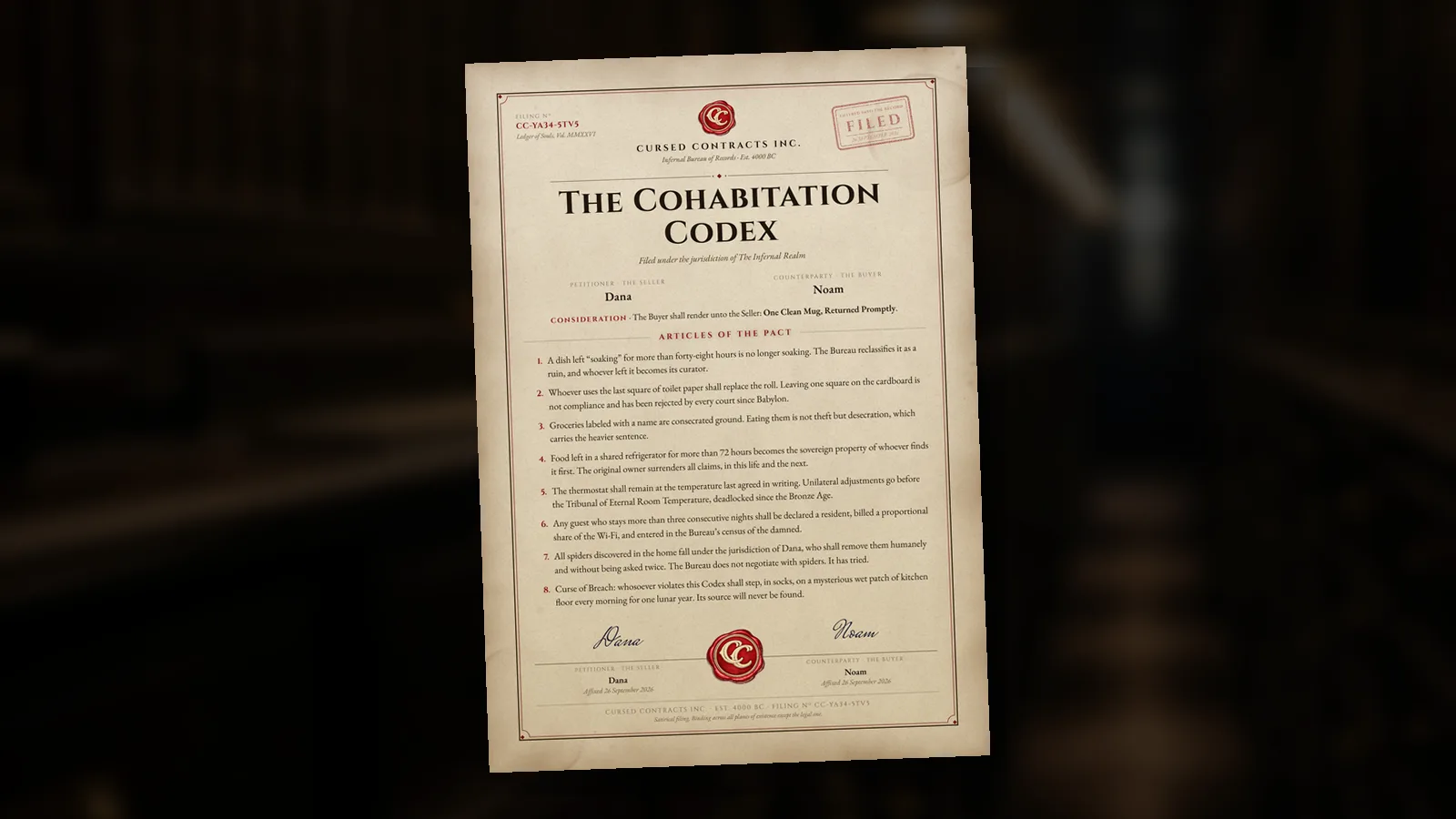
Most roommate arguments are not about the thing being argued about. They are about an expectation one person had and never said out loud. A roommate agreement fixes that by saying it out loud, once, in writing, before anyone is annoyed.
This guide covers what a roommate agreement should include. It is house rules between people, not a lease: it sits beside your rental contract and does not replace it. For anything with legal force (who is on the lease, deposits, notice periods), your lease and local law decide. For the dishes, you decide.
The practical part
Agree these first. They cause the real damage when left vague.
Rent and deposit
- Who pays what share, and whether it is split equally or by room size.
- The date each person transfers their share, and to whom.
- How the deposit is split when someone moves out.
Bills and shared purchases
- Which bills are shared (electricity, internet, water, streaming) and whose name each is in.
- How shared purchases (toilet paper, dish soap, olive oil) are tracked. A shared note or a splitting app ends most disputes before they start.
Chores
- A rota, written down, with a named person for each job each week. "Everyone just does their bit" is not a rota.
- A definition of clean for the kitchen and bathroom. One sentence each is enough.
Guests and partners
- How much notice is expected before an overnight guest.
- How many nights in a row before a guest starts sharing costs.
Quiet hours and the thermostat
- Quiet hours on work nights.
- An agreed temperature range, and who may change it.
Moving out
- How much notice a roommate gives the others, and who finds a replacement.
The part people actually read
Once the practical terms are settled, the Bureau recommends writing the recurring small disputes as formal clauses. The formality is the point: a rule written with the gravity of a court order is harder to ignore and easier to laugh about. These are the clauses roommates file most often:
A dish left "soaking" for more than forty-eight hours is no longer soaking. The Bureau reclassifies it as a ruin, and whoever left it becomes its curator.
Whoever uses the last square of toilet paper shall replace the roll. Leaving one square on the cardboard is not compliance and has been rejected by every court since Babylon.
Groceries labeled with a name are consecrated ground. Eating them is not theft but desecration, which carries the heavier sentence.
Food left in a shared refrigerator for more than 72 hours becomes the sovereign property of whoever finds it first.
The thermostat shall remain at the temperature last agreed in writing. Unilateral adjustments go before the Tribunal of Eternal Room Temperature, deadlocked since the Bronze Age.
Any guest who stays more than three consecutive nights shall be declared a resident and billed a proportional share of the Wi-Fi.
All spiders discovered in the home fall under the jurisdiction of one named roommate, who shall remove them humanely and without being asked twice.
Every one of those is a real rule about soaking dishes, toilet paper, labelled food, old leftovers, temperature, guests and spiders. They are simply written so that nobody minds being reminded of them.
How to agree it without an argument
- Draft it together, ideally in the first week. A roommate agreement written after a fight reads like a charge sheet.
- Keep it to one page. If it runs longer, the practical terms belong in a shared note and the page holds the rules.
- Both sign it. A signature is what turns a suggestion into a rule people remember agreeing to.
- Put it somewhere visible. The inside of a kitchen cupboard door works. So does a frame by the fridge.
- Review it when someone moves in or out. New roommate, new signatures.
The Bureau's standard instrument
The Bureau files roommate agreements as the Cohabitation Codex: the clauses above, the parties named as Roommate A and Roommate B, a consideration of One Clean Mug, Returned Promptly, and a curse of breach involving a mysterious wet patch on the kitchen floor. You can edit it clause by clause, send it for countersignature, and have it printed for the fridge. Drafting is free.
For agreements between friends rather than flatmates, see how to write a friendship contract.