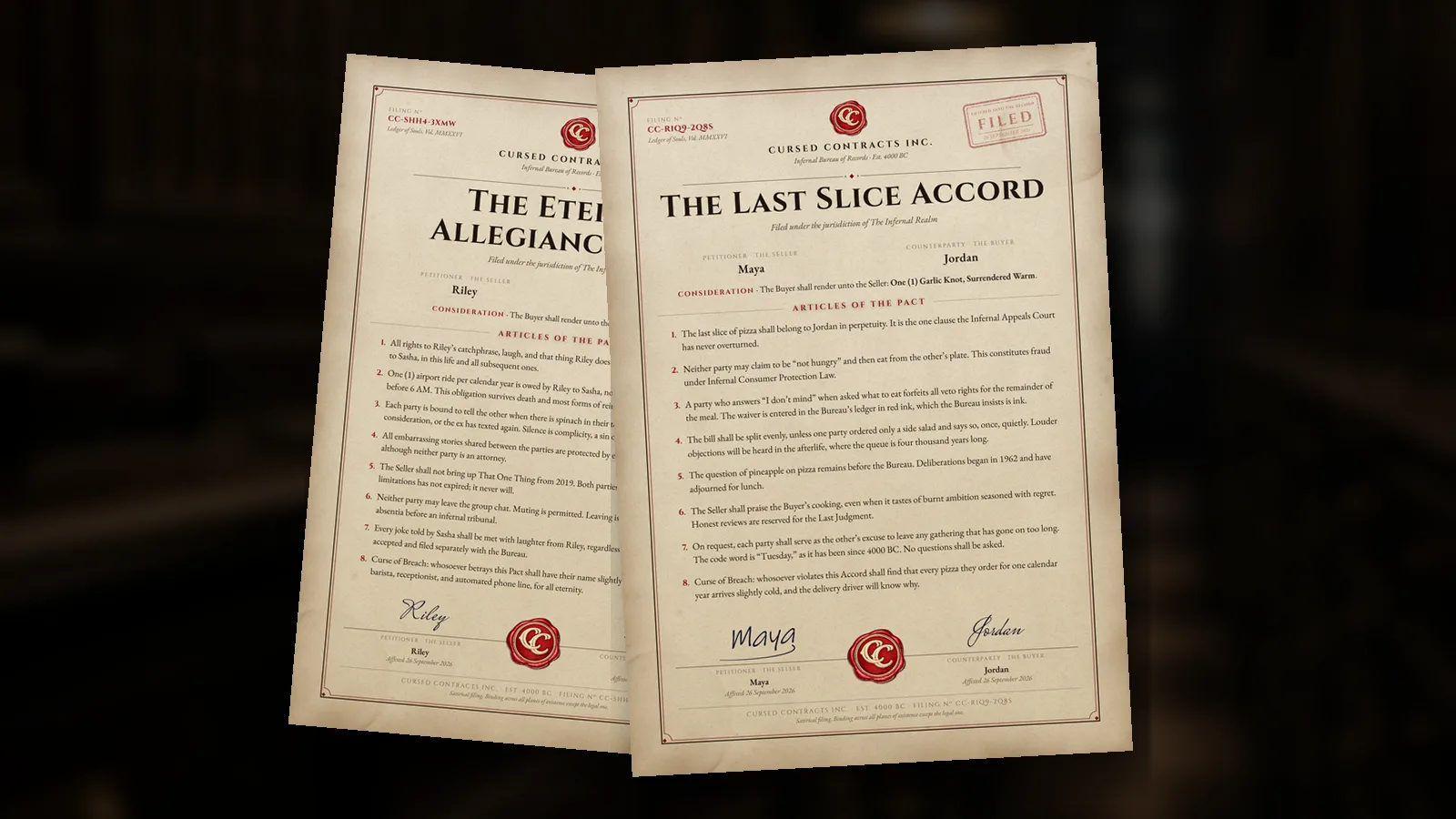
A friendship contract is a joke that only works if it is taken seriously. The Bureau has processed a great many of them, and the ones that get framed share a structure. Here it is, in the order you will need it.
1. Name the parties properly
"Me and Sam" is not a party list. Give each signatory a full name, or the name everyone actually uses, and a formal role. The Bureau's instruments use titles such as Friend of the First Part and Best Friend of Record. A formal title on a document about pizza is most of the joke already.
If your contract is between more than two people, choose the two who are most likely to break it.
2. State the consideration
Every contract needs something exchanged, and that something should be small, specific and slightly absurd. Some examples from the Bureau's files:
- One (1) Garlic Knot, Surrendered Warm
- First Claim on Every Last Slice
- Three (3) favors, redeemable without explanation
- One Clean Mug, Returned Promptly
Money is allowed, but a number of garlic knots is funnier than a number of dollars.
3. Write clauses about real behavior
This is where friendship contracts succeed or fail. A generic clause ("both parties shall be good friends forever") gets a polite smile. A specific clause about something that actually happens gets read aloud to other people.
Think about the recurring disputes, habits and rituals in the friendship: who drives, who texts back, who eats off whose plate, who still brings up something from years ago. Then write the rule down with the solemnity of a court order. A few from the Bureau's register:
One (1) airport ride per calendar year is owed by the Seller to the Buyer, no questions asked, including departures before 6 AM. This obligation survives death and most forms of reincarnation.
Neither party may leave the group chat. Muting is permitted. Leaving is desertion and will be tried in absentia before an infernal tribunal.
The Seller shall not bring up That One Thing from 2019. Both parties know which thing. The statute of limitations has not expired; it never will.
Each party is bound to tell the other when there is spinach in their teeth, a regrettable haircut is under consideration, or the ex has texted again. Silence is complicity, a sin of the fourth class.
Six to eight clauses is the right length. Fewer, and it reads like a card. More, and nobody reaches the end.
4. Hide one sincere clause
The best friendship contracts contain exactly one line that is not entirely a joke. The spinach clause above is really a promise to be honest. The airport ride is really a promise to show up. You do not need to point this out. Your friend will notice.
5. End with a curse of breach
Every Bureau filing closes with a penalty for anyone who violates it. It should be proportionate, petty and permanent:
Curse of Breach: whosoever betrays this Pact shall have their name slightly mispronounced by every barista, receptionist, and automated phone line, for all eternity.
6. Sign it, date it, seal it
A friendship contract is not finished until both parties have signed it. A drawn signature is better than a typed one, and the countersignature is the moment the joke lands, so send it to them rather than signing both lines yourself. A filing number, a seal and a date make it look like something that belongs on a wall, which is where the good ones end up.
Clause ideas for different friendships
The register above suits most pairs. Some friendships need their own terms:
- Long-distance friends. "Each party shall answer a voice note within one calendar week. Voice notes longer than nine minutes may be answered in summary."
- A friend group of three or more. "Plans proposed in the group chat are binding only once three members have replied with something other than a thumbs up."
- Friends who travel together. "The party who booked the accommodation may not be blamed for the accommodation."
- Friends who eat out. "The bill shall be split evenly, unless one party ordered only a side salad and says so, once, quietly."
- Friends who leave parties together. "On request, each party shall serve as the other's excuse to leave any gathering that has gone on too long. The code word is 'Tuesday.'"
For fifty more, sorted by relationship, see the Bureau's funny contract ideas.
When to give a friendship contract
A friendship contract works best with an occasion attached, because the occasion explains why you are handing someone a legal-looking document:
- A birthday. The most common filing. Sign it at dinner, in front of witnesses.
- A friendship anniversary, for friends who keep track of such things.
- One of you moving away. Add the long-distance clauses and the airport ride.
- Asking someone to be a bridesmaid or best man. Add a clause binding them to the role, and to the speech.
- No occasion. The Bureau approves unprompted filings. They are the most suspicious kind, and therefore the most effective.
More gift approaches are in the Bureau's best friend gift ideas.
Mistakes the Bureau sees most often
- Writing it alone and presenting it as finished. Leave one clause blank for your friend to write. Joint authorship makes a better document.
- Clauses that are secretly complaints. "Party B shall stop being late" is a grievance with a seal on it. Make the clause funny enough that Party B wants to sign.
- Too many clauses. See section 3. Nobody reaches clause fourteen.
- No date. A friendship contract is a record of a particular year. Date it so the next one can be compared.
After the signatures
A signed friendship contract tends to get screenshotted, laughed at and lost. The Bureau's preference is that it be kept. The Company Store issues any filed contract through Etsy as a Certified Copy (about US$7: a sealed PDF, a copy with blank signature lines for signing by hand, and a phone wallpaper, delivered after purchase), an unframed matte print (about US$29) or a print in a black wooden frame (about US$64). Prints are made to order in five to seven days and ship free to the US, EU, UK, Canada and Australia.
Re-sign it every year with one new clause. The old copies become precedent.
The short version
- Formal names and titles.
- A small, specific, absurd consideration.
- Six to eight clauses about real behavior.
- One sincere clause, unmarked.
- A curse of breach.
- Both signatures, a seal and a date.
The Bureau keeps two standard friendship instruments with all of this done for you: the Last Slice Accord, which governs shared meals and the final slice, and the Eternal Allegiance Pact, for the friend who already knows too much. Both can be edited clause by clause, sent for countersignature, and printed. Drafting is filed at no cost.
Frequently asked questions
What should a friendship contract include?
Formal names for both friends, a small and specific consideration, six to eight clauses about real habits (food, lifts, the group chat, old embarrassments), one quietly sincere clause, a curse of breach for whoever breaks it, both signatures and a date. Specific clauses about actual behavior are what make it worth framing.
Is a friendship contract legally binding?
No. A friendship contract from the Bureau is a satirical document, written to be signed, laughed at and kept. It creates no legal obligations, and nothing in it should cover money, property or anything that matters in court. Its authority is social: once a friend has signed, they will be reminded.
How do I make a friendship contract for my best friend?
Start from the Eternal Allegiance Pact or a blank instrument on the filing desk, rewrite the clauses around your real history together, sign it, then send it for their countersignature rather than signing both lines yourself. Their reaction to the fine print is the gift. Frame it afterwards if they sign.
Choosing how to keep the finished pact? Consult the guide to free drafts, digital copies and printed filings before ordering.